Foreign exchange trading, often called forex, is the exchange of one currency for another. The market supports global trade, travel, and cross-border payments.
In the latest BIS Triennial Survey, OTC FX trading reached $9.6 trillion per day in April 2025. This figure is widely used as the main benchmark for market size.
In Nigeria, online access has made forex trading more visible to the public. At the same time, the forex space in Nigeria has been linked with scams and misleading ads. A case in point was the Crypto Bridge Exchange (a.k.a CBEX), as published on Techcabal, where thousands of Nigerians lost their life savings to crypto scams.
Nigeria’s Securities and Exchange Commission, SEC, has warned that online retail forex trading is currently unregulated (public notice dated Oct 19, 2018). The SEC has also published enforcement updates against online trading platforms.
This guide explains core terms, how pricing works, common costs, and key risks. It also covers Nigeria-specific context, such as WAT trading hours and safety checks.
RELATED ARTICLES: include Is Forex Trading Legal in Nigeria? and Best Time to Trade Forex in Nigeria (WAT). This article is for education and general information only.
Key Forex Terms Every Nigerian Beginner Must Know
Forex trading is based on currency pairs. A pair shows one currency priced in terms of another.
Currency Pairs
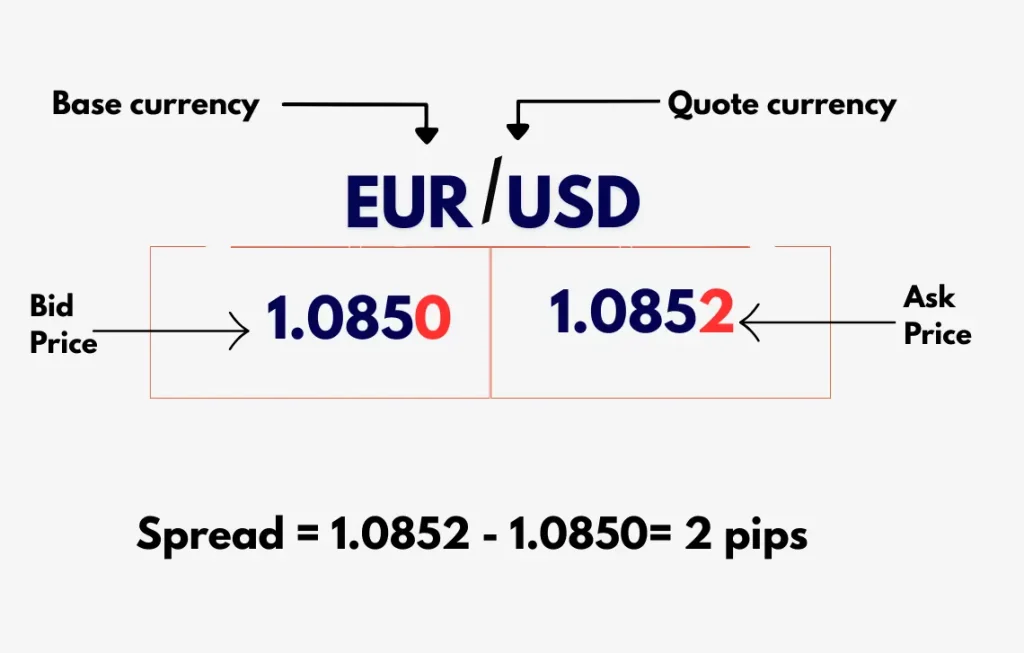
A currency pair has two parts:
- Base currency (first)
- Quote currency (second)
Example: EUR/USD.
EUR is the base currency.
USD is the quote currency.
If EUR/USD is 1.1000, it means one euro equals 1.10 dollars.
Bid, Ask, and Spread
Quotes often show two prices:
- Bid: the price used for selling the base currency
- Ask: the price used for buying the base currency
The gap is the spread. It is the difference between the bid price and ask price. The spread is a common trading cost. Get more details on spreads from Investopedia. Spreads usually widen when liquidity is low. They also widen during fast news-driven moves.
Pips
A pipis a standard unit for price movement. For many pairs, a pip is 0.0001.
Investopedia’s pip definition explains the common rule.
Example: If EUR/USD moves from 1.1000 to 1.1005. That move equals 5 pips.
Lots and position size
A lot is a standard size used to describe trade volume. Common lot sizes are shown below.
|
Lot type |
Units of the base currency |
|
Standard lot |
100,000 |
|
Mini lot |
10,000 |
|
Micro lot |
1,000 |
|
Nano lot |
100 |
Lot size affects both risk and pip value.
Pip value
Pip value depends on the currency pair and the size of the trade. For pairs quoted in USD, pip value is often expressed in USD first. It can then be converted to naira using the prevailing naira exchange rate. This section stays educational and avoids personal advice.
Leverage and margin
Leverage allows a trader to take a larger position with a fraction of the funds in their trading account and the rest borrowed from their broker.
Margin is the amount set aside to support that position. Investopedia’s leverage overview explains the core idea.
Leverage can increase gains and losses from small moves. That is why risk controls matter later in the guide.
Margin calls and forced closes
A margin call can happen when equity falls too low. Platforms may then require more funds or reduce exposure. Some platforms also close positions automatically at set levels.
Common costs
Forex trading costs vary by account type and venue. The most common costs are shown below.
|
Cost type |
What it means |
|
Spread |
Difference between bid and ask |
|
Commission |
A separate fee charged per trade |
|
Swap / overnight fee |
Fee or credit for holding positions overnight |
Simple example of a price move
Assume EUR/USD moves 10 pips in one direction. The gain or loss depends on position size and pip value. The same 10 pips can mean different results when the lot size changes. With these terms defined, the next section explains what moves forex prices.
RELATED READINGS: Best time to trade forex in Nigeria (WAT)
The will to win, the desire to succeed, the urge to reach your full potential these are the keys that will unlock the door to personal excellence.
What moves Forex Prices?
With the basic terms clear, the next question is price movement. Forex prices change when demand and supply for a currency change. Because trading is global, many different factors are responsible for changes in the exchange rates.
Supply and Demand in the FX Market
In most major markets, exchange rates are market prices. They reflect how many people want to buy or sell a currency. When demand rises, a currency can strengthen against others. When supply rises, it can weaken.
The BIS describes forex as a very large, active market. Daily turnover reached $9.6 trillion in April 2025. High turnover often supports liquidity, but price moves still occur.
Interest Rates and Central Bank Policy
Interest rates shape how attractive a currency can look. When rates rise, foreign funds may flow into that currency. When rates fall, those flows may slow or reverse. Central banks influence this through policy choices and guidance. Those signals can shift expectations before rates even change. This is one reason central bank meetings often move FX markets.
In Nigeria, the exchange rate policy sits with the Central Bank of Nigeria. CBN documents describe its role in exchange rate management.
Inflation and Growth Data
Inflation data can affect how markets price future rates. High inflation can weaken a currency in many settings. Growth data can also matter because it changes rate expectations. Common releases include inflation, jobs, and GDP reports.
Markets often react to surprises, not the headline alone. A “better than expected” number can move prices quickly. A “worse than expected” number can do the same.
Trade Flows and Commodity Prices
Trade flows affect currency demand in a direct way. Imports raise demand for foreign currency to pay suppliers. Exports raise demand for the local currency from foreign buyers.
For Nigeria, oil still drives a large share of FX earnings. The World Bank notes oil’s role in fiscal revenue and FX earnings. This can link the naira’s pressure to oil price swings. It can also link FX supply to export receipts timing.
Risk Sentiment and Sudden News
Currencies also move on risk mood in global markets. In “risk-off” moments, flows can shift toward safe assets. In calmer periods, flows can move back to higher-yield markets. Big news can also move prices fast. Examples include elections, conflicts, sanctions, and policy shocks. These events often affect trade, capital flows, and confidence.
Trading Hours, Liquidity, and Nigerian Time
Market activity changes across the day. Price movement can look different during active sessions. Spreads may widen when liquidity is thin, and moves are sharp. Nigeria’s timing is covered in more detail here: Best Time to Trade Forex in Nigeria (WAT). Next, this guide narrows down and examines the legality or otherwise of forex trading in Nigeria.
Is Forex Trading legal in Nigeria?
After looking at how prices are determined in the foreign exchange(forex) market, next we take a look at what the law says regarding forex trading in Nigeria and whether any Nigerian is permitted by law to engage in it. Discussions on the subject matter is often done under 2 broad headings: One is legality. The other deals with regulation.
Legal vs regulated
In everyday use, “legal” often means “not banned by law.” “Regulated” often means a public agency sets rules and checks conduct.
This difference matters because many online ads use the words loosely. As a result, a platform can be active online, yet still lack local oversight.
What the SEC has said about online retail forex
Nigeria’s Securities and Exchange Commission (SEC) issued a public notice on Oct 19, 2018. The notice states that online retail forex trading is unregulated in Nigeria.
The SEC states that online retail forex trading is currently unregulated and may be subject to abuses. The notice also states that participation is at the participant’s own risk until the agency develops a framework to regulate online forex trading in Nigeria.
This position is often referenced in discussions about “is forex trading regulated in Nigeria.”
A more detailed explanation can be accessed here: Is Forex Trading Legal in Nigeria?.
Enforcement updates and public alerts
Alongside the 2018 notice, the SEC has also published enforcement updates. These updates include blacklists and alerts tied to unregistered online trading platforms.
For example, the SEC announced the blacklisting of six unregistered online trading platforms in April 2023.
The SEC also issued an “Illegal Operator Alert” about Pocket Option in July 2025, stating it was not registered or authorized to operate in Nigeria’s capital market.
These alerts most times do not cover every platform in the market. However, they show how the SEC communicates investor protection actions over time so the Nigerian public can be aware and take necessary precautions.
The CBN and Nigeria’s official FX Market
Nigeria’s official FX market also involves the Central Bank of Nigeria (CBN). The CBN launched the Nigerian Foreign Exchange (FX) Code on Jan 29, 2025. The FX Code outlines principles for conduct in the FX market.
This is different from how many retail platforms advertise leveraged trading online. That split is why “regulated market rules” and “online retail offers” are often discussed separately.
A recent example of ongoing FX reform is a CBN step on BDC FX supply announced Feb 11, 2026. The FX reform only covers the official FX access and compliance, not online platform forex trading.
Common misunderstandings seen in Nigeria
Discussions about legality often mix up terms used in adverts. Common patterns include:
- “Registered” means company registration, not market oversight.
- “Licensed” is used without naming a relevant regulator.
- “Guaranteed returns” language tied to trading outcomes.
How to start forex trading in Nigeria (step by step)
This section explains how to start forex trading in Nigeria step by step in general terms. It describes what online retail trading platforms commonly require and how key steps are usually presented. This section is for education and general information only.
What this section covers
- How brokers and platforms are commonly compared
- Account opening and identity checks (KYC)
- Demo accounts and live accounts
- Popular platforms and mobile access
- Deposits, withdrawals, and common scam patterns
- Order types and a simple trade example
1) Platform and broker selection
Online retail forex trading is typically offered through a broker and a trading platform. The broker provides pricing and execution through its systems and partners.
Comparisons often group broker features into four areas:
- Status and disclosures (how oversight and registration are described)
- Costs (spread, commission, and overnight charges)
- Tools (charts, order types, account reporting)
- Operations (deposits, withdrawals, and support)
In Nigeria, this topic often links back to regulatory risk. In a public notice issued by the SEC, they stated that online retail forex trading is unregulated in Nigeria.
RELATED ARTICLE: Is forex trading legal in Nigeria?.
2) Account opening and identity checks (KYC)
Many platforms request identity checks before full access is granted. This is often described as customer due diligence or KYC in financial services.
At a global level, FATF standards describe customer due diligence as a core requirement. In Nigeria, the CBN also publishes KYC guidance used across financial services.
The process of obtaining KYCs can vary based on the provider; the process commonly involves identity and address checks. Some providers also apply extra checks during fund withdrawals.
Nigeria’s FX policies also place emphasis on dealing with approved operators. A CBN notice on licensed BDCs states that only BDCs listed by the CBN are authorised to operate. This sits alongside the wider point that identity checks and traceable payments are common in regulated finance.
Related reading: 5 ways to choose a forex broker in Nigeria.
3) Demo accounts and live accounts
A demo account uses simulated funds with live market prices. It is often used to learn platform functions and order handling.
A live account uses real funds and live execution. As a result, costs like spread and slippage can be felt more directly. Key definitions are covered in: Forex basics: how the market works.
4) Trading platforms and mobile access
Retail forex trading is often done through desktop and mobile platforms. Mobile trading matters in Nigeria because many traders access the forex markets from their mobile phones.
Two of the most popular trading platforms today are MT4 and MT5. Both support charts, indicators, order placement, and account history. Differences often appear in the account structure and order handling.
RELATED ARTICLE: MT4 vs MT5 for beginners.
5) Deposits and withdrawals in Nigeria
Funding and withdrawal methods depend on the provider and its banking partners. In many cases, payment channels often include bank transfers and card payments. However, options may vary. Processing time can also vary due to platform checks and bank timelines. Because of that, “instant withdrawal” claims are often treated as marketing language.
In Nigeria, official FX access and compliance rules change over time. For example, a CBN update dated February 11, 2026, allowed licensed BDCs to access weekly FX amounts through authorised dealer banks, with conditions around KYC and electronic reporting.
While this is not the same as online retail leveraged trading, it shows how FX distribution is linked with compliance, reporting, and traceability.
Scam patterns also show up around deposits and withdrawals. Examples include fake “tax” requests, clearance fees, or “account upgrade” charges. The SEC also posts circulars and enforcement updates for public awareness.
6) Order types used in forex
Orders are instructions on how to enter or exit a trade. The names and descriptions of the order types usually vary slightly depending on the broker you choose for your retail trading activity. However, the following main types are common:
| Order type | General meaning |
| Market order | Aims to fill at the best available price |
| Limit order | Seeks to fill at a chosen price or better |
| Stop order | Triggers when the price reaches a set level |
These definitions are general and educational. Execution rules, minimum sizes, and slippage handling differ by provider.
7) A simple trade example (educational)
Assume EUR/USD is around 1.1000. A position is opened with a size of 10,000 units (often called a mini lot).
In many common examples, a 1-pip move on that size is about $1 when USD is the quote currency. This is a simplified illustration used to explain sizing and pip value. A Nigeria-focused conversion example appears here: Pip value in naira.
If the price moves 10 pips in one direction, the result is about $10 before costs. If price moves 10 pips in the other direction, the result is about -$10 before costs. Final results also reflect spread, possible commission, and slippage.
This example shows why position size affects outcomes. The same pip move can mean different results across lot sizes.
8) Common misunderstandings seen in Nigeria
Online adverts often mix terms in ways that confuse readers. Common patterns include:
- “Registered” means company registration, not market oversight
- “Licensed” used without naming a relevant regulator
- “Guaranteed returns” language tied to trading outcomes
SEC public notices and enforcement updates are one place where official warnings appear.
Related reading: Is forex trading regulated in Nigeria?.
Common questions about forex trading in Nigeria
Is forex trading regulated in Nigeria?
Nigeria’s SEC has stated that online retail forex trading is unregulated in Nigeria. The SEC also publishes enforcement updates and alerts tied to unregistered operators.
Is forex trading regulated in Nigeria?
Nigeria’s SEC has stated that online retail forex trading is unregulated in Nigeria. The SEC also publishes enforcement updates and alerts tied to unregistered operators.
Is forex trading banned in Nigeria?
“Not banned” and “regulated” are not the same thing. Public notices focus more on risk and lack of regulation, not a blanket ban.
Can forex trading be done in Nigeria?
Many retail platforms offer mobile apps for charts and order placement. Mobile access does not change market risk or platform rules.
What is the time to trade forex in Nigeria?
Market activity changes across the day, based on global sessions. Liquidity is often higher during major session overlaps. General session timing is explained in market-hours references.
Why do many traders loose money ?
Losses are often linked to leverage, costs, and fast price moves. Small moves can have large effects when positions are oversized.
What do forex scams in Nigeria often looks like?
Many scams use “guaranteed returns” claims or fake clearance fees. The SEC posts circulars on suspected fraudulent activities over time.